
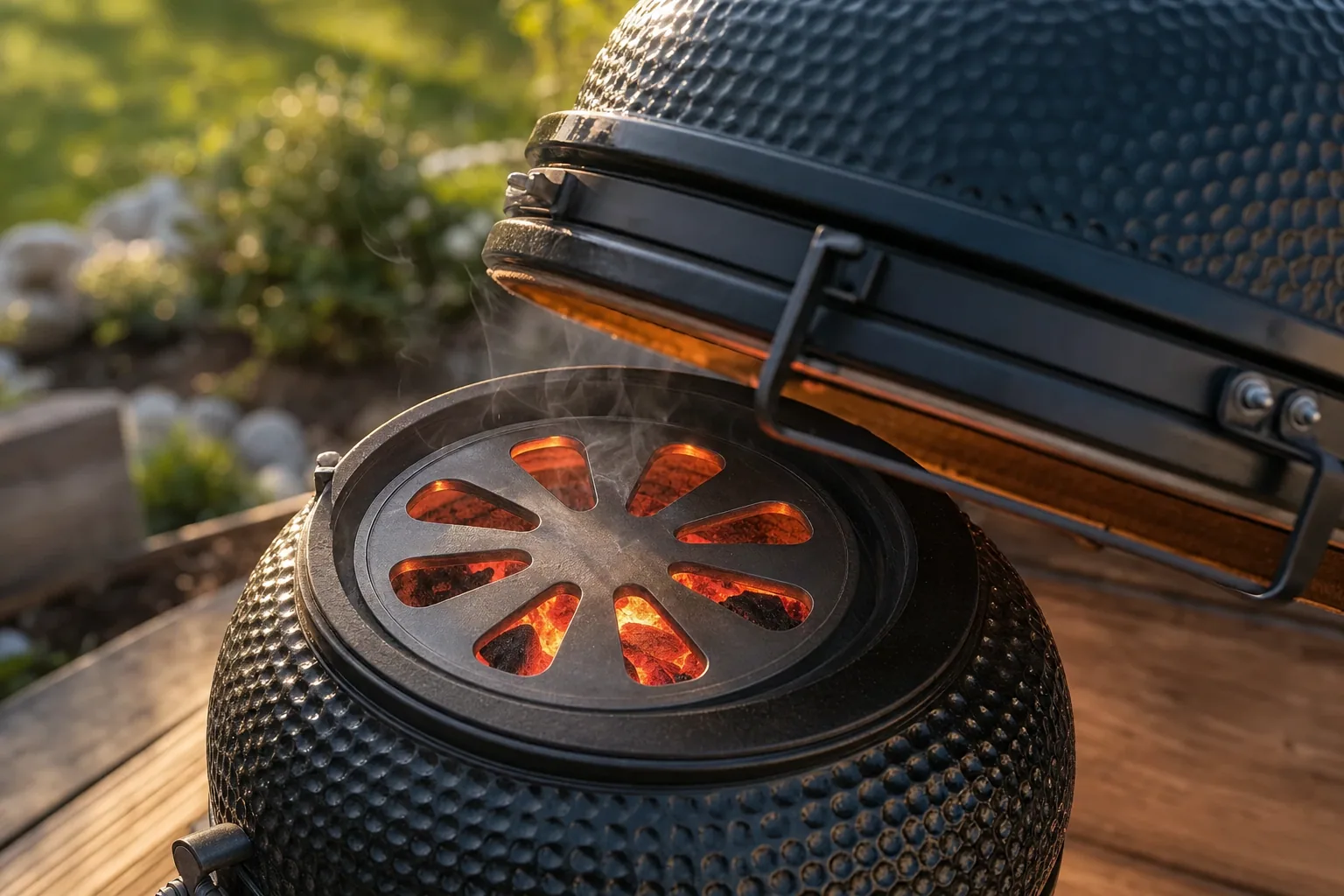
Understanding Charcoal Grill Vents
Charcoal grills depend on a simple but critical principle: oxygen fuels the fire, and controlling airflow controls temperature. Every charcoal grill features vents, also called dampers or adjustable air openings, located at the bottom (intake) and top (exhaust) of the grill. These vents are the primary tool for managing heat from the moment you light your charcoal until your meal is ready.
When you open vents wider, more oxygen flows to the coals, making them burn hotter and faster. When you close them partway, you restrict oxygen, lowering the temperature and extending your cook. This relationship between vents and temperature is what separates a mediocre charcoal cook from a skilled one.
The Role of Intake and Exhaust Vents
Charcoal grill airflow works in a two-part system: air flows in through the bottom intake vents and out through the top exhaust vents. The intake vents sit near the base of the grill, often built into the bottom grate or the grill body itself. The exhaust vents sit on the lid or upper dome.
The intake vents supply fresh oxygen to the coals, directly influencing how hot they burn. The exhaust vents allow hot air and smoke to escape. Together, they create a draft that pulls air through the fuel bed. If you close both partially, you create a steady, controlled burn. If you open both fully, the fire becomes aggressive and intense.
Understanding this two-way flow is essential. Some griller beginners focus only on the top vents, but the bottom intake vents are equally important. In fact, the bottom vents typically have more impact on temperature because they control the primary oxygen supply to the coals.
How to Use Grill Vents for Temperature Control
Mastering how to use grill vents starts with simple experimentation on a day when you're not serving dinner. Here's the practical approach:
- Light your charcoal and allow it to ash over, roughly 15 to 20 minutes for a full chimney starter.
- Open both the intake and exhaust vents fully and let the grill stabilize for 5 to 10 minutes. Note the temperature.
- Gradually close the bottom intake vents halfway. Watch the temperature begin to drop.
- Close the top exhaust vents halfway as well. The temperature will continue to fall and stabilize at a lower level.
- Make small adjustments every few minutes and let the grill settle before making another change. Temperature vents respond slowly, so patience is key.
For high-heat searing, open both sets of vents fully and let the grill run hot, typically 400 to 500 degrees Fahrenheit or higher. For low-and-slow smoking or indirect cooking, close the intake vents to roughly 25 to 50 percent open, which typically holds temperatures around 225 to 275 degrees Fahrenheit.
Write down the vent positions that produce your target temperatures. Every grill is slightly different due to design, seal quality, and weather, so your own notes become a valuable reference.
Temperature Control Vents in Different Grill Styles
Different charcoal grill designs offer varying levels of vent control and finesse. Traditional kettle-style grills feature a simple bottom vent and a top vent with basic open-close positions. Ceramic grills like Kamado Joe models offer more precise adjustable vents that allow for finer temperature increments. Digital grills with automated fan systems, such as certain Masterbuilt models, actively control airflow electronically, removing much of the guesswork.
If you choose a ceramic grill like a Kamado Joe charcoal cooker, the thick walls retain heat better than traditional steel, so the vents have a more dramatic effect on temperature. Small vent adjustments in a ceramic grill can shift temperature by 50 degrees or more.
For traditional charcoal grills, the vent design may be simpler, requiring larger adjustments to achieve the same temperature changes. Digital and automated models remove the need for manual vent adjustment altogether, making them appealing for cooks who want consistent results without constant monitoring.
Common Vent Mistakes to Avoid
Many charcoal griller beginners make predictable errors when first learning vent management. The most common mistake is making large, rapid vent adjustments and then checking temperature immediately. Charcoal grills have thermal lag. It can take 10 to 15 minutes for a temperature change to stabilize, so impatient adjustments lead to overshooting your target and creating frustration.
Another frequent error is forgetting to open vents when starting a cook. If you light charcoal and close all vents, you will suffocate the fire and it will go out. Always open the vents fully when lighting, then gradually close them down once your coals are established and you're ready to set your temperature.
A third mistake is neglecting the bottom intake vents. Some cooks focus only on the top exhaust vent and wonder why temperature control feels sluggish. The bottom vents are typically the more sensitive control point, so start adjustments there.
Finally, avoid leaving vents half-open and forgetting them. Temperature drift is real. If you walk away and forget to adjust vents as your coals age, temperature will gradually drop as the coals shrink and ash accumulates.
Tips for Precision Vent Management
Once you understand the basics, a few refinements can elevate your charcoal grill game. First, keep your grill clean. Ash buildup around the vents restricts airflow unpredictably. Before each cook, empty the ash bin and brush out the grate area so vents are clear.
Second, monitor your external temperature with a quality thermometer. An instant-read digital thermometer is cheaper than learning through burnt or undercooked meals. Place the thermometer probe at grate level where your food will sit.
Third, make vent adjustments in small increments. Rather than swinging a vent from 25 to 75 percent open, move it from 25 to 40 percent and wait. Small, deliberate changes teach you how responsive your specific grill is.
Fourth, understand that outside weather affects vent response. A windy day can make vents less effective at controlling temperature because wind adds oxygen. On calm days, the same vent position may run hotter. Adjust slightly for conditions.
Choosing a Charcoal Grill with Reliable Vents
When shopping for a new charcoal grill, pay attention to vent design. Look for grills with smooth-moving, well-sealed vents that don't stick or rattle. Poor-quality vents with gaps or loose hinges make precise temperature control nearly impossible.
Ceramic grills typically offer the most responsive and durable vents because they are engineered for precision. Traditional steel kettles are affordable and reliable, though vent control is less granular. Digital grills with electronic dampers offer the ultimate in set-and-forget convenience if precision and automation matter most to you.
Prime Grill Shop carries a range of premium charcoal grills from trusted brands. Whether you want a classic ceramic cooker or a modern digital model, the focus is always on quality construction and reliable airflow control so you can cook with confidence.
Final Thoughts
Charcoal grill vents are not mysterious. They are simple, mechanical controls that regulate oxygen and heat. By understanding how intake and exhaust vents work together, making gradual adjustments, and keeping your grill clean, you can master temperature control and unlock the full potential of charcoal cooking. The investment in learning your grill's vent response pays off in consistent, delicious meals and the confidence that comes from knowing you're in control of the heat.