
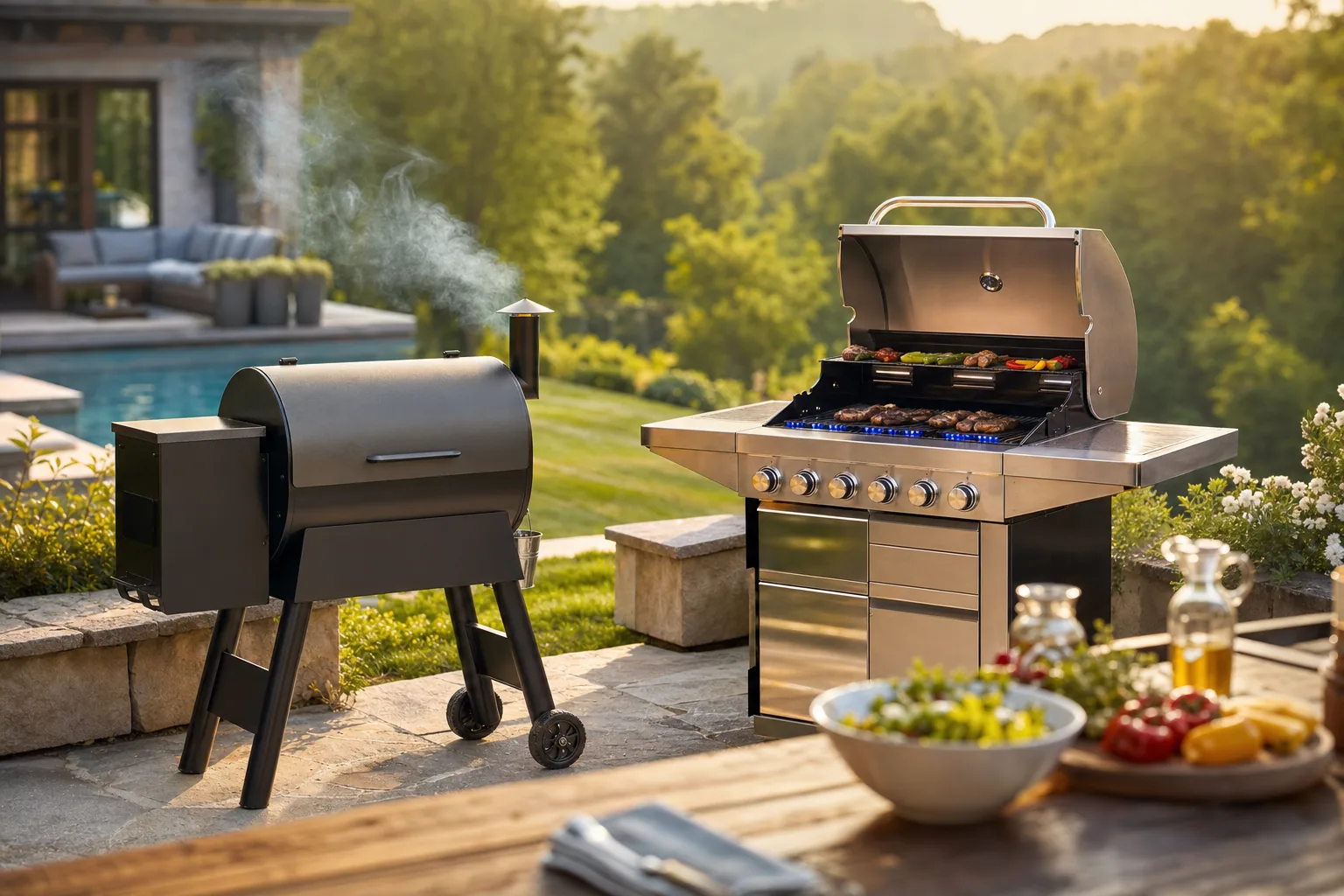
When it comes to outfitting your backyard for serious cooking, the pellet grill vs gas grill debate is one of the first decisions you'll face. Both options have loyal fans, strong arguments in their favor, and real trade-offs worth knowing before you spend a significant amount of money. This guide cuts through the noise and gives you a clear, honest comparison so you can choose the grill that fits the way you actually cook.
How Each Type of Grill Works
Understanding the mechanics helps explain why each grill behaves differently at the cook.
A gas grill runs on propane or natural gas. You turn a knob, hit an igniter, and within a few minutes you have consistent, controllable heat. Temperature adjustments are instant, much like cooking on a stovetop. The fuel is widely available, and the process is familiar to most backyard cooks.
A pellet grill uses compressed hardwood pellets as both its fuel and its flavor source. An electric-powered auger feeds pellets from a hopper into a firepot, where they burn and generate both heat and smoke. A digital controller manages the auger speed to hold a set temperature. The result is a cooking environment that behaves more like a convection oven than a traditional grill, with a genuine wood-smoke character layered into everything you cook.
Flavor: Where the Biggest Difference Lives
If flavor is your top priority, the pellet grill comparison is hard to ignore. Pellet grills produce real wood smoke from the moment the cook starts. Whether you choose hickory, cherry, apple, or mesquite pellets, that choice shows up in the finished dish. Briskets, ribs, whole chickens, and even vegetables pick up a depth of flavor that a gas grill simply cannot replicate on its own.
Gas grills are not flavorless. High-quality gas grills with infrared burners, like the Napoleon Prestige series available at Prime Grill Shop, create intense searing heat that delivers excellent crust development and great char. The flavor profile is clean, honest, and lets the quality of your protein speak for itself.
The bottom line: if wood-smoke flavor matters to you, pellet wins. If you want pure, clean heat with a great sear, gas is a strong contender.
Convenience and Ease of Use
This is where the gas grill or pellet grill question often gets decided for busy households.
Gas grill advantages:
- Ready to cook in under 10 minutes
- No electricity required
- Instant temperature adjustments by hand
- Simple cleanup with no ash management
- Consistent performance in cold weather
Pellet grill advantages:
- Set-and-forget temperature control via digital or Wi-Fi controllers
- Even, consistent heat across the cooking surface
- Doubles as a smoker, roaster, and low-and-slow BBQ machine
- Minimal active monitoring once the cook is dialed in
If you want to fire up dinner on a Tuesday night in under 15 minutes, gas has the clear edge. If you love weekend cooks where you set a temperature in the morning and come back to a perfectly smoked pork shoulder eight hours later, pellet grills are hard to beat.
Versatility: What Can Each Grill Actually Do?
Gas grills handle high-heat tasks extremely well. Steaks, burgers, chops, vegetables, and seafood all thrive over a hot gas flame. Many premium gas grills include side burners, rear infrared rotisserie burners, and multiple cooking zones that let you run different temperatures simultaneously.
Pellet grills are arguably the more versatile machine overall. A quality pellet grill can smoke low and slow at 180 degrees, roast a whole chicken at 375 degrees, and in many models, reach searing temperatures above 500 degrees. Brands like Memphis Grills, which Prime Grill Shop carries, have pushed pellet grill technology to a point where the gap between pellet and gas searing performance is much smaller than it used to be.
If you can only have one grill, a pellet grill covers more cooking styles. If you already have a smoker or just want a reliable, fast cooker for everyday meals, gas is a perfectly complete solution.
Cost and Long-Term Investment
Both gas and pellet grills span a wide price range. Entry-level models in both categories can be found for a few hundred dollars, but at the premium end, where Prime Grill Shop focuses, you are looking at quality products that are built to last for many years.
A few cost factors worth considering:
- Fuel costs: Propane and natural gas tend to be cheaper per cook than hardwood pellets, though the difference is modest at the frequency most backyard cooks use their grill.
- Electricity: Pellet grills need an outlet nearby, which adds a small ongoing operating cost.
- Maintenance: Pellet grills produce ash that needs periodic cleaning. Gas grills require occasional burner and grate cleaning, but no ash management.
- Longevity: Both types, when bought from reputable brands, offer excellent durability. Buying from an authorized dealer like Prime Grill Shop ensures you get the full manufacturer warranty, which matters a lot at these price points.
Making the Final Call
Here is a simple way to think about the pellet vs gas grill decision:
Choose a gas grill if you cook frequently throughout the week, value speed, want dead-simple operation, and prioritize a clean sear over smoky flavor.
Choose a pellet grill if you love weekend cooks, want wood-smoke flavor built into every meal, and appreciate the kind of hands-off temperature control that lets you actually enjoy time with your guests instead of babysitting a fire.
Many serious backyard entertainers end up with one of each over time, and that is a completely reasonable outcome.
At Prime Grill Shop, the goal has always been the same: help you find the right equipment so your backyard becomes the kind of place people want to gather. Whether that means a Napoleon gas grill for fast weeknight dinners, a Memphis Grills pellet grill for weekend smoking sessions, or something in between, the team is here to help you figure it out. Browse the full grill collection at Prime Grill Shop, and if you have questions, call (970) 681-9122 to talk it through with someone who genuinely knows the products.